Greek Kabala Series
Greek Kabala Part 8
by Jack Courtis
We are still dealing with a prostitute, Mary Magdalene. Why is she so important to the Christian story? When we discover her importance, we shall understand why she embarrasses the old theology so much. Remember that she anoints Jesus and thereby confers upon him the status of Christ. This is a ritual of profound significance. It is a "kingmaking". When she is criticized for using such an expensive ointment, Jesus upholds her authority, at John 12:7,8. But that still does not explain why a woman is anointing Jesus and why he allows her to do so. After all that was not Jewish custom at the time.
Jesus and Mary Magdalene take part in the IeroV GamoV (Ieros Gamos), the Sacred Wedding. The old theology carefully avoids this issue because it is a pagan practice of the era that we are dealing with. At this time in Palestine, a man is made a legitimate king if he has sexual union with the High Priestess. He can only receive his full divine power through the authority of the High Priestess. Without her, his claim to kingship is invalid. The embarrassment of the Church is obvious. We too feel embarrassed, because we have no concept of sacred sexuality. This is not about physical sex, personal gratification or eroticism. It is the belief that in the sacred marriage, the man and woman become as gods and experience the divine. Thus the High Priestess acting as a channel for the divine blesses the king and confers authority upon him. The Sacred Wedding is the ultimate expression of temple prostitution. The body of the Priestess is a metaphor for the gateway to the gods.
Note carefully that in this belief system, a man needs a woman to approach the gods, but a woman does not need a man. She is in touch with the divine automatically. Hence in the Quest for the Holy Grail, it said that although men must search for the Grail, women already have it.
But we have not yet finished with Mary Magdalene. In her day, the mystery schools of Osiris, Tammuz, Dionysios, and Attis, had a rite that required the symbolic death of the god, played by a priest. After three days, the Priestess in the role of the goddess revives the god. During the ritual she says, "They have removed my lord and I do not know where to find him." Why is this relevant to the theology that we are developing? Read John 20:2 where Mary Magdalene says:
They have taken away the Lord out of the sepulchre, and we know not where they have laid him.
And again at 20:13 Mary Magdalene tells the angels:
They have taken away my Lord, and I know not where they have laid him.
Do you still doubt the importance of Mary Magdalene? Clearly she is fulfilling the role of the High Priestess. That is why she acts with authority and bestows the status of Christ on Jesus; and that is why he allows her to do so in defiance of Jewish custom. But there is more.
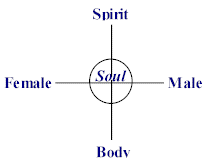
There is a modern view that the Wedding in Cana (John 2:1-11) refers obliquely to the actual marriage of Jesus and Mary Magdalene. Obviously, this is speculation but it makes sense in the context of the Sacred Wedding. What happens in Cana? Jesus and his disciples are "called" to the wedding. There he participates by turning water into wine. In the parable of that era, water symbolizes the human body and wine symbolizes the spirit, both as vehicles of consciousness. By changing water into wine, Jesus transforms consciousness from biological to spiritual. And what is a wedding? It is the lawful union, according to kosmic law, of our male and female natures. What about the soul? The diagram below makes the point clear. It is a process of integration that places the soul as a vehicle of consciousness, in its correct place.
Have we finished with Mary now? Not quite. Remember we are dealing with the path that connects Goodness with First Principle. This is the path of pain and sorrow. Upon this path is the non-sphere of Knowledge. The gnostic myths tell us that as an Aeon, Sofia desired to conceive but did so without the concurrence of the masculine principle, that is the masculine did not know her. Refer to Genesis 4:1 and recall that Adam knew Eve and she conceived and gave birth. Sofia did not act this way. She gave birth without the masculine and hence this was a "virgin" birth. What was born? The Demiourgos (Demiurge), the creator god who in turn created the kosmos, a kosmos without Knowledge and therefore in need of redemption and a Redeemer. However Sofia is above the Demiurge and he has no power over her. That is why we can look to her for healing and salvation. We need redemption and salvation. We need a Redeemer and through her personification as the Virgin Mary, we have Him.
Mother
Now at last, we can consider the virgin birth of Jesus. It is clear from Matthew 1:25, that Joseph did not have sexual relations with Mary before she gave birth to her son. We have already seen that the Greek word parthenos means "virgin". We cannot avoid the issue.
If we look at the Tree of Life, we are dealing with the letter F (fi) and the element Air. It is the path connecting Glory and First Principle. It is very appropriate as the third feminine step because First Principle contains the pattern of order and Glory is the pattern of salvation made manifest. Why else is Jesus born? He is the Redeemer made manifest, who will lead us to salvation. The Tree is itself a pattern of order and as we move along it, we see how it is consistent with the theology we are developing.
It is easy enough to understand Mary the mother of Jesus as the personification of the creative aspect of Sofia. However this still does not explain the virgin birth in terms we can comprehend. The path we are considering has attributed to it the letter F (fi). This is the first letter of the Greek word F w V (fos) which means "light". This word is used in six different ways in the New Testament, but the meaning that is significant for understanding the Virgin Birth is in John 8:12, where Jesus says, Egw eimi to fwV tou kosmou ("I am the light of the world"). We then compare that with John ch 1 v 3-5,
All things were made by him; and without him was not any thing made that was made.
In him was life; and the life was the light of men.
And the light shineth in the darkness; and the darkness comprehended it not.
The key to the Virgin Birth is the "light" that emanates from the masculine aspect that is within the "life" of the First Principle. The "darkness" is the feminine aspect of the First Principle. To make the point clearer, the Tao is the differentiated unity of the "light" masculine Yang and the "dark" feminine Yin. Just as the Tao simply "is" according to Chinese philosophy, in that manner the First Principle is "self-originate" in the gnostic myth. Thus the true nature of the Virgin Birth lies in the self-originated nature of the First Principle. At the end, we see the Virgin Birth as a deep mystery that can only be understood when we have travelled all the paths on the Tree of Life, with the aid of the 12 spiritual disciplines.
The fundamental point is this: The Mother is Sofia giving birth to the Redeemer.
*******
Let us review the first three steps on the feminine journey by seeing them in the context of whole of that journey.
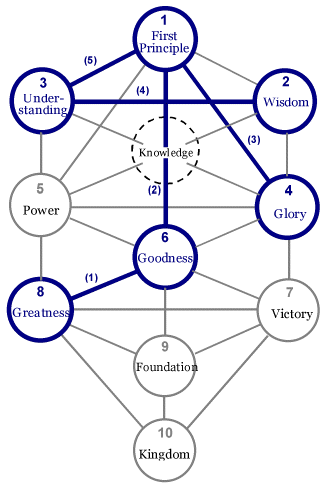
The first step from Greatness to Goodness leads directly into the second step from Goodness to First Principle. So the Virgin Mary and Mary Magdalene follow in sequence. The third step from Glory to First Principle is Mary the Mother. With the fourth step, we shall see Mary as the Widow and finally with her Assumption, Mary will be seen as the personification of Sofia.
