Greek Kabala Series
Greek Kabala Part 1
by Jack Courtis
We are familiar with Hebrew kabala to such an extent, that we assume that this is the only kind of kabala there is. Not so.
The basic point about kabala is that in languages that have no symbols for numbers, letters stand for numbers and numbers stand for letters. This was true of both the Greek and Hebrew languages at the time of Christ. The significance of this is that the Old Testament was written in Hebrew and the New Testament was written in Greek. Therefore there was a Hebrew kabala and there was a Greek kabala. Thus a word could be translated into a number and a number could be translated into a word. The classic example of Hebrew kabala is from the Old Testament:
- In Genesis we are told of the Serpent who is called in Hebrew, Nachash. The total numerical value of his name is 358.
- At the time of Christ, the Jews were expecting the Messiah, whose numerical value is also 358.
- Thus the Serpent that brings the Fall is also the Messiah who brings the Redemption.
- But there is more. The number 358 consists of the 3rd, 4th and 5th numbers in the Fibonacci series: 1, 2, 3, 5, 8, 13, 21, 34, 55, 89….. This series of numbers is related to the Greek mystical number j also known as the golden number. It is the way in which to calculate and draw geometrically, the mean and extreme ratios. In turn, this was one way in which the Greeks taught the abstract principle of the Logos. Further, the numbers 3, 4 and 5, describe the Pythagorean Triangle. Its internal angles are 90°, 37° and 53°. The Hebrew word mem (water) has the value of 90. This is the "living water" or "elixir of life", of the Rosicrucian Philosophers. In the Confessio Fraternitatis, the Rosicrucians give 37 reasons for their existence. The Hebrew word ehben (stone) has a value of 53. This is the "Stone" of the Rosicrucian alchemists. Finally, the Hebrew name Moses has a value of 345. These are random examples to give you an idea of what is going on.
Now for the classic example of Greek kabala in the New Testament, from the Apocalypse of John ch 13 v 18 (King James version): "Here is wisdom. Let him that hath understanding count the number of the beast: for it is the number of a man; and his number is Six hundred threescore and six." In Greek, the key phrase: "…..kai o ariqmoV autou cxV " (and his number is 666). What does this mean? The Greek numerical value of the entire key phrase is calculated as follows:
kai .....o .... ....ariqmoV ............autou ......... ..cxV
31 + 70 + 430 + 1171 + 666 = 2,368
So what? It all depends on whether 2,368 has a specific meaning with theological significance. Try this:
Jesus Christ = IhsouV CristoV = 888 + 1480 = 2,368
This is not the kind of theology that either Jews or Christians are used to. However it points the way to the valid use of kabala as a source of inspiration and revelation. Put simply, both the Old and New Testaments are written in code and it takes a great deal of effort to understand it. However cracking the code brings Wisdom and Understanding in their kabalistic sense. So much has been written about Hebrew kabala that it is not proposed to repeat much of that here. Instead we shall concentrate on Greek kabala in order to gain an appreciation of early Christianity.
The Greek and Hebrew alphabets have a common origin and therefore it is not surprising that we shall find similarities between the two forms of kabala. Thus the Greek and Hebrew Trees of Life have a very similar structure but subtle differences in their paths. First the Hebrew Tree. Its structure is derived from Genesis Ch 1 where:
- There are 10 references to "God said";
- There are 3 references to "God made";
- There are 7 references to "God saw"; and
- There are 12 single references to "God".
Thus there are 10 sefirot, 3 horizontal paths, 7 vertical paths and 12 diagonal paths. The Hebrew Tree of Life is shown below.
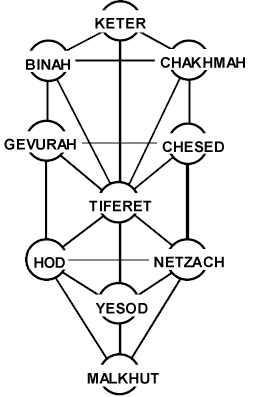
The Hebrew alphabet has 22 letters and an internal structure of 3 Mothers, 7 Doubles and 12 Singles. The Greek alphabet has 24 letters and an internal structure of 5 alchemical letters, 7 planetary letters and 12 zodiacal letters. The correlation is very close. The difference is that the 3 Hebrew Mothers consist of only 3 alchemical letters: alef (air), mem (water) and shin (fire); whereas the 5 Greek alchemical letters correlate to all 5 elements, aether, air, fire, water, earth. Thus the Hebrew scheme lacks the activating principle of aether and the grounding principle of earth.
Both the Greek and Hebrew Trees have 10 spheres: in Greek sferes (plural) and sfera (singular); while in Hebrew sefirot (plural) and sefira (singular). Notice the similarities? We have seen the derivation of the 10 sefirot of the Hebrew Tree. How are the 10 spheres of the Greek Tree derived? In the Apocalypse of John 1:8, Christ says:
Egw eimi to ... A kai . to .. W ..... arch ... kai teloV
I am the Alfa and the Omega beginning and ending
How many words do you see? There are 10. For reasons that we shall see in Part 2 of this series, arch is more properly translated as "First Principle". Further, teloV means "ending" in the Aristotelian sense of "purpose". That is in the First Principle there is the purpose for which the "I am" exists. All of this becomes intelligible on the Greek Tree of Life.
Both Trees have 3 pillars with similar meanings. We shall deal with that topic separately.
Let us now turn our attention to the 10 spheres of the Greek Tree of Life and its 24 paths. The names of the spheres and pillars are adopted from the New Testament and the Greek Orthodox liturgy written by St John Chrysostomos in the 5th century CE. The attributions of the paths are taken from early Greek Christian and Gnostic sources. Hidden subtly in the structure of the paths is the "ascent of the soul" that is explained in great detail in the Gnostic Books of Ieou. Look for the order of the planets. It is the Ptolemaic order and is quite different from the order on the Hebrew Tree. This difference points to a different theology and a different way to salvation.
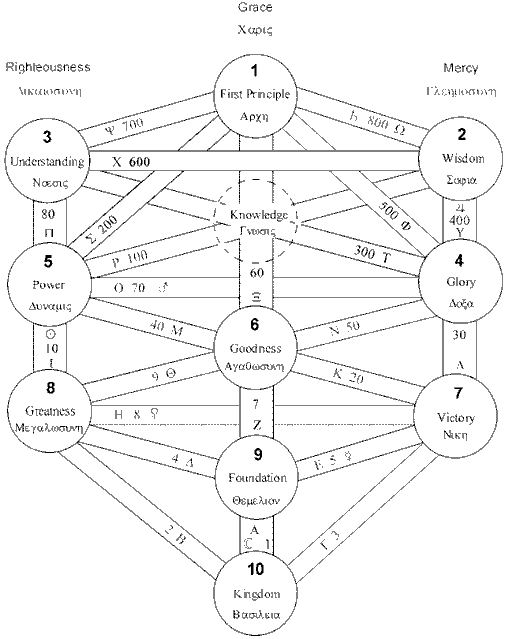
There are three issues for us to consider in our personal search for salvation, using the Greek Tree of Life:
- The attribution of the Greek letters to alchemy and astrology means that we can translate the titles of the Greek spheres into our personal alchemical and astrological functions. This is because of the Hermetic principle of: as Above, so Below. The Tree of Life is a kosmic blueprint for our internal spiritual structure.
- The ascent of the soul that is portrayed on the Tree, gives us a clue as to how to direct our lives with the clear intention of influencing our future incarnations.
- We can relate the spheres and paths of the Greek Tree to the Gospels and derive a new appreciation of theology.
These issues will be taken up in the following articles of this series. Finally, the relationship between Greek and Hebrew kabala is analogous to the relationship of the Fibonacci spirals on a sunflower head. They are very similar, but different and need to be seen together in order to be understood properly. Observe the diagram below.
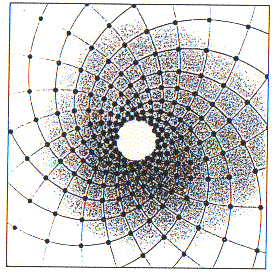
We shall get a true appreciation of the subtle nature of the scriptures when we see how the two Trees of Life interact.
