Bacon & The Rose Cross
by James Phinney Baxter (1831-1921)
[From his book: "The Greatest of Literary Problems, the authorship of the Shakespeare Works; an exposition of all the points at issue, from their inception to the present moment" 1915]
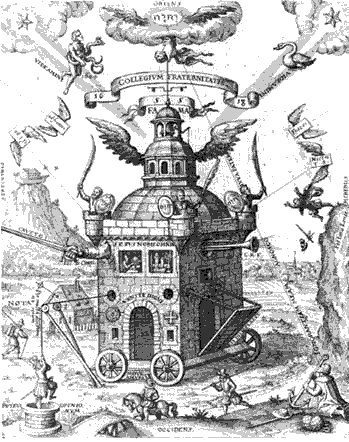
The Temple of the Rosy Cross, a symbolic figure designed by Teophilus Schweighardt Constantiens by the Grace of God and Nature, Unchangeable Forever, 1618
Much has been said of Bacon's connection with that influential Society which flourished in England in the reigns of Elizabeth and James, known as "Rosicrucian," whose very existence was so carefully concealed that few outside of it's fellowship knew of its existence. At what date in the world's history it originated we will hardly venture to inquire; it is sufficient to our purpose that the public announcement of its existence occurred in 1614, when was published in Cassel the " Allegemeine and General-Reformation der ganzen weiten Welt." This work declares that it was first formed by four persons only, and by them was made the magical language and writing, with a large dictionary, which we yet daily use God's praise and glory.
Says Mackey:--
Many writers have sought to discover a close connection between the Rosicrucians and the Freemasons, and some, indeed, have advanced the theory that the latter are only the successes of the former. Whether this opinion be correct or not, there are sufficient coincidences of character between the two to render the history of Rosicrucianism highly interesting to the Masonic student.(Albert G. Mackey, An Encyclopedia of Freemasonry, vol.II p.639. 1912
In England, there still exists a society of Rosicrucians which was "founded upon the remains of the old German association." We are told that:
Modern times have eagerly accepted, in the full light of science, the precious inheritance of knowledge bequeathed by the Rosicrucians.... It is not desirable, in a work of this kind, to make disclosures of an indiscreet nature. The Brethren of the Rosy Cross will never and should not, at peril and under alarm, give up their secrets. This ancient body has apparently disappeared from the field of human activity, but it's labors are being carried on with alacrity, and with a sure delight in an ultimate success. (Beyond Masonic Cyclopadia. London, 1877)
Among the members of the ancient Society appear these initials, " Fra. F.B.; M.P.A.; " which, plainly stated, stand for Francis Bacon, Magister, Pictor, Architectus. Waite, perhaps the best historian of the Rosicrucian Order, introduces it to us in these words:-
Beneath the broad tide of human history there flow the stealthy undercurrents of the secret societies which frequently determine in the depths the changes that take place upon the surface. The facts and documents concerning the Fraternity of the Rose Cross are absolutely unknown to English readers. Even well-informed people will learn with astonishment the extent and variety of the Rosicrucian literature, which hitherto has lain buried in rare pamphlets, written in the old German tongue, and in Latin commentaries of the later alchemists.
Says Heckthorne:--
A halo of poetic splendor surrounds the order of the Rosicrucians; the magic lights of fancy play round their graceful day dreams, while the mystery in which they shrouded themselves lends additional attraction to their history. But their brilliancy was that of a meteor. The literature of every European country contains hundreds of pleasing fictions, whose machinery has been borrowed from their system of philosophy, though that itself has passed away. (C.W.Heckthorne, Secret Societies in All Ages and Countries. London, 1897
The writer has long been a member of the Masonic order of the Red Cross, which is popularly supposed to have inherited the title from the Rosicrucian Brotherhood, a supposition which, having a knowledge of the history of this and other societies akin to Masonry, he believes to of doubtful validity.
The title of the Brotherhood is derived from Rosa-Crux, a red rose affixed to a cross, presumably of gold. So many intellectual subtleties have been employed by fanciful theorists in attempts to explain the precise signification of these ancient symbols, believed to be older than the Christian era, that their more obvious and truer significance has been unnecessarily obscured. To the Rosicrucians of the age of Elizabeth, it hardly seems questionable that the rose was the symbol of silence, as among the ancients it was originally derived from the pagan tradition that the God of Love made the first rose, which he presented to the God of Silence. From this tradition originated the custom of carving a rose on the ceilings of banquet halls, or rooms where people met for gayety and diversion, to intimate that under it, whatever was spoken or done was not to be divulged; hence our term sub rosa used to indicate secrecy.The Cross,of course, signified salvation, to which the Society of the Rose-Cross devoted itself by teaching mankind the love of God and the beauty of brotherhood, with all that they implied.
The following has been recognized as having been written by Bacon, and will not be doubted by any acquainted intimately with his style:-
I was twenty when this book was finished; but methinks I have outlived myself; I begin to be weary of the sun. I have shaken hands with delight, and know all is vanity, and I think no man can live well once but he that could live twice. For my part I would not live over my hours past, or begin again the minutes of my days; not because I have not lived well, but for fear that I should live them worse. At my death I mean to make a total adieu of the world, not caring for the burthen of a tombstone and epitaph, but in the universal Register of God I fix my contemplations on Heaven. I writ the Rosicrucian Infallible Axiomata in four books, and study, not for my own sake only, but for them that study not for themselves. In the law I began to be a perfect clerk; I writ the idea of the Law, et., for the benefit of my friends, and practice in King's Bench.(the reader is referred to Bacon's Historia Vitae et Mortis, and legal writings including the Attorney's Academy.) I envy no man that knows more than myself, but pity them that knows less..... Now, intake midst of all my endeavours there is but one thought that dejects me, that my acquired parts must perish with myself, nor can be legacied amongst my dearly beloved and honoured friends.
The striking phrase, "I begin to be weary of the sun," is duplicated in "Macbeth," v, 5: "I 'gin to be a weary of the sun."
We would gladly indulge in a more comprehensive exposition of this interesting fraternity were it not necessary to limit ourselves to a single member of it, Francis Bacon, its putative head in England, though Robert Fludd, whom Waite describes as "the great English mystical philosopher of the seventeenth century, a man of immense erudition, of exalted mind, and, to judge by his writings, of extreme personal sanctity,"(A. S. Waite, The Real History of the Rosicrucians, p.283 London 1887.) was its chief exponent. Of course he was a friend of Bacon, if the latter belonged to the English fraternity, and so must have been Maier, the chief among German writers of the order, who was also in England the year of the actor's death(Shakespere) and Bringern, another associate with him in upholding the honor of Rosicrucianism on the continent. It is to this association that we desire to call especial attention.
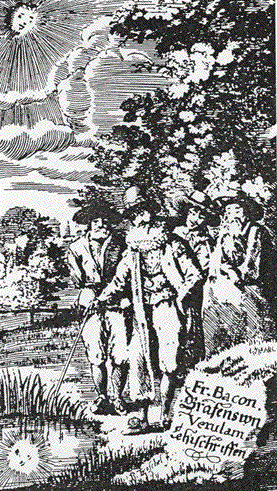
Rosicrucian Title-Page to Francis Bacon's De Sapientia Veterum German translation 1654, depicting Bacon as head of the Rosicrucian Society with three officers, or principles, attending him
In 1617 a year after the death of the Stratford actor, Fludd was in Frankfort engaged in seeing his "Defence of Rosicrucianism" through the press. At the same time Bringern was printing the "Fama Fraternitatis." In this work appears, on pages 52 and 53, the following :--
We must earnestly admonish you that you cast away, if not all, yet most of the worthless books of pseudo chymists (the term "chymist" used figuratively signified poets or romanticists.) to whom it is a jest to apply the Most Holy Trinity to vain things, or to deceive men with monstrous symbols and enigmas, or to profit by the curiosity of the credulous; our age doth produce many such, one of the greatest being a stage player, a man with sufficient ingenuity for imposition; such doth the enemy of human welfare mingle among the good seed, thereby to make the truth more difficult to be believed, which in herself is simple and naked, while falsehood is proud, haughty, and colored with a lustre of seemingly godly and humane wisdom. Ye that are wise eschew such books and have recourse to us, who seek not your moneys, but to offer unto you our great treasures.
The allusion is evidently to the Stratford actor, for the plays, as well as Bacon's other works, are saturated with Rosicrucian thought. Dr. Ingleby should include it in a new edition of his "Allusions." Certainly it is much clearer than many he has published. But further to identify the actor with the titles "false poet" and "stage player" we will call attention to a method which these literary Bo-Peeps had of revealing their meaning to the initiated. If they wished to inform their reader who a person alluded to was, they placed the allusion on a page the number of which corresponded so the number which he was known,or to the date of some well-known event connected with him. This allusion was placed on pages 52 and 53 ; the first to indicate the age of "false poet and stage player," which was 52, and the second to show the relation between him and Bacon, whose number as we shall see later was 53.
It may be asked, why did a member of the Brotherhood and friend of Bacon speak of the plays in this manner if he knew they were the work of a good Rosicrucian? It should be understood that in the Brotherhood the largest liberty of expression was allowed, and that many, especially those who were of Puritan extraction, looked upon the stage with abhorrence. Bringern was among these, and took this way of expressing his disapproval of mingling things sacred and profane. He was occupied, as so many are even in our day, with methods of reform, while Bacon was looking to results.
The Rose-Cross order is greatly misunderstood. Writers upon the subject have permitted themselves to be led astray form the motive which vitalized it, and have been hoodwinked by its mysteries, as though it exalted mystery above faith, the shadow above the substance, paying scant heed to the patent fact, that secrecy, was its only safeguard against rack and thumbscrew. It was not a searcher for gold, but a Christian organization composed of studious and thoughtful men, impressed by the mysteries amidst which the Creator had placed them, and which Science and Philosophy have ever been striving to solve. They were mystical, --how could they be otherwise?--and were regarded as heretics, or free-thinkers, then synonymous terms, though now they would be called conservative, for history teaches that the error of one age may be the truth of a later one.
There were many in Elizabeth's reign who chafed at the restrictions, and abhorred the obsequious attitude which placed and power imposed them; but though the Advancement of Learning was the cornerstone of their temple, they naturally differed as to methods of advancement. Some among them, like Bacon, found in Poetry and Romance he most convenient vehicles for delivering to the world, either by means of the printed page or the living drama, the truths they so ardently desired it to possess. The influence of these upon the literature of the Elizabethan age is evident, and if it is true that the caged bird sings sweeter than the free, the saying may furnish a reason for its matchless charm. To the mind of the writer, Swedenborg's ethically religious system, which makes the dual precepts,love to God and love to man, its science, quite faithfully expresses that of the Rosicrucians. To love God and man sufficiently to serve both to the best of their ability was their religion, and realizing the wickedness about them, they undertook a crusade of education to lead men to a recognition of their duty to God and their fellows, the "Universal Reformation of the Whole Wide World." These mysteries were simply cloaks to protect them from danger,not it is true, of modern style, though fantastic garb is still all too much in evidence in the world; for then, Religion and even Science sported strange attire, and they naturally reflect the fashion of their time. It was an age of isms in which men flung loose the jesses of Fancy, and soared aimlessly amid the drifting clouds of fiction, or were ensnared in the toils of superstition; an age in which men mad with the lust of power crushed with mailed heel those with helplessness should have been their protection. But in no age has God been without faithful witnesses, who, braving the terrors of torture and death, were ready to give their lives to the emancipation of their fellowmen, and it was among such that Rosicrucianism found a proper field for it activities.
Unless we pay less attention to the peculiarities of their outward habiliments, and more to them as men, living the common life, and sharing the common aspirations of thinking and well-meaning mortals, we shall fail to understand them.
It is interesting to note that the Rosicrucian Brotherhood especially flourished in England during Bacon's life, and that its existence was not made known to the world, and then on the Continent, until the year of the actor's death. We have already spoken of Maier, the Rosicrucian Protagonist, and of his sojourn in England. Returning to Frankfort, he published in September, 1616, five months after the actor's death, three works, one being his "Lusus Serius," which he dedicated to a triumvirate of Rosicrucians, at whose head appeared Don Francisco Antonio, Londin, Anglo, Seniori. This combination of the names of Francis and Anthony, the latter of whom had been dead fifteen years, was of course, understood by the Brotherhood, among whom such books only found readers. To have dedicated it openly to Francis Bacon might have attracted unpleasant attention, if, by chance, it fell under the eye of any but a friend, though at this time, while it might have been injurious, it might not have been dangerous if it had been known that he was a member of the Brotherhood. It is suggestive to note that in his book Maier gives us a paraphrase of the story of Christopher Sly in the "Taming of the Shrew," which he uses to point a moral. Maier concludes the story by restoring the poor sot to his former condition, while in the play he is left unrestored.
This story of Sly, Wigston interprets as showing the relation between the actor and Bacon, the former representing "a man of low extraction, set up like a nobleman by Bacon in his own place with regard to plays or players." (Maier's paraphrase, under the title of the Waking Man's Dream, may be found in the Shakespeare Library of Hazlitt. Cf. Francis Bacon, etc. versus Phantom Captain Shakespeare, et.,p.xxxii et seq.London, 1891).
It is certainly suggestive that Sly, in the "Taming of the Shrew", remains unrestored to his former condition, as if to suggest that the joke of the actor's false role on the stage of literature was to go on while it continued to amuse the world. The story of Sly is in the Quarto of 1594. It is worth noticing that parts of the play are duplicated in Tamburlaine and Faustus, whose assumed author died in 1593.
When we come to the consideration of Symbolism, we shall learn more of the secret methods employed by Rosicrucians for conveying information, though many of them may never be fully disclosed. It should be noted that the stronghold of the Brotherhood was in England, and that its period of greatest influence was during Bacon's life.
Of the fact that Bacon was a Rosicrucian, Spedding, in his preface to "The New Atlantis," shows himself to have been entirely oblivious. Had he known this, John Heydon's Voyage to the Land of the Rosicrucians" would have opened to him a line of thought which would have greatly enlightened him, for Heydon's "Voyage," largely word for word the same, would have enabled him to understand many passages in his author's works ever which he puzzled in vain. "The New Atlantis" was published in 1627, after Bacon's death, by Rawley, his executor, in connection with the "Sylva Sylvarum," as Bacon "designed," says Spedding, and "Solomon's House," or "The Temple of Wisdom"--as Heydon has it--"is nothing more than a vision of the practical results which he anticipated from the study of natural history diligently and systematically carried on through successive generations,"and that "of it has told us all that he was yet qualified to tell."
Talbot, Heydon's biographer, gives the date of his birth as 1630, four years after Bacon's death. He represents him as a great traveler, and a man of high character. How it came for him to use almost the same description of his penetration into the riddle of Rosicrucianism that Bacon used in his "fable" which Rawley says " he devised to the end that he might exhibit therein a model or description of a college instituted for the interpreting of nature, and the production of great and marvelous works for the benefit of men, under the name of Solomon's House, or the College of the Six Days' Works?" A fair answer seems to be that Bacon used a sketch for his "Atlantis" familiar to the Hermetic Brotherhood, which was limned by him as its head, to exhibit what might be accomplished by wise means for the regeneration of society, making some minor changes to adapt it to a new purpose, and that Heydon, who was a Rosicrucian, unaware of the existence of Bacon's "Atlantis," preserved for the world the original or an accurate copy of it. It is, however, as reasonable to suppose that Heydon becoming acquainted with the "Atlantis," in his admiration of a work in which he discerned the embodiment of the Rosicrucian spirit, adopted it as an exposition of the beauty and strength of the Holy House.
In commenting upon Bacon's "Atlantis," Spedding justly says:---
Perhaps there is no single work of his which has so much of himself in it. The description of Solomon's House is the description of the vision in which he lived-- the vision not of an ideal world released from the natural conditions to which ours is subject, but of our own as it might be made if we did our duty by it, of a state of things which he believed would one day be actually seen upon this earth, such as it is, by men such as we are, and the coming of which he believed that his own labors were sensibly hastening.
Before dismissing this phase of our subject, let us compare extracts from the "Atlantis" and Heydon's " Voyage."
A study of the two books from which these few and brief extracts are made, in connection with the works of Waite, Wigston, and Hargrave Jennings on the Rosicrucians, opens to us a realm of thought to which so many of us in our less trammeled age are oblivious, and helps in blazing a way to a conception of what has seemed to us a fantastic and futile method for one of the greatest intellects which the world has known, to employ in playing his role on the human stage. This conception is reached when we clearly understand that Rosicrucianism meant in the seventeenth century the universal brotherhood of humanity; that it was a society closely allied to Freemasonry; derived its cult through the same channels from the event-- the building of Solomon's House; employed the same symbols, and that the Invisibles, as the Rosicrucians entitled themselves, worked by hidden ways to bring about their proposed reformation of society, and found that the field of literature afforded sure and safe highways to human minds--the highways of Philosophy, Science, and History; Poetry, Romance, and Drama; reached in the one instance by different paths of abstract thought, experiment, analysis, and comparison; in the other by the more alluring byways of imagination and fancy. Reaching this conception, a comprehension of Bacon's literary methods, and even of the cipher mystery, becomes less difficult; in fact, difficulties quite vanish when one reflects that the reformer of our day works in the same way, and uses the same means that the Invisibles did, but with this difference, that he labours in the sunshine of hope, while they wrought in the shadow of fear.
From the "New Atlantis"
The father of the Family, whom they call the Tirsan, two days before the feast, taketh to him three of such friends as he liketh to choose; and is assisted also by the governor of the city or place where the feast is celebrated; and all the persons of the family, of both sexes, are summoned to attend him. These two days the Tirsan sitteth in consultation concerning the good estate of the family. Then, if there be any discord or suits between any of the family, they are compounded and appeased.
From Heydon's "Voyage to the Land of the Roscicrucians"
The Father of the fraternity, whom they call the R.C., two days before the feast taketh to him three of such friends as he liketh to chase, and is assisted also by the governor of the city where the feast is celebrated, and all the persons of the family, of both sexes, are summoned to attend upon him. Then, if there be any discords or suits, they are compounded and appeased.
From the "New Atlantis"
And as we were thus in conference, there came one that seemed to be a messenger, in a rich hue, that spake with the Jew; whereupon he turned to me and said: "You will pardon me, for I am commanded away in haste." The next morning he came to me again, joyful as it seemed, and said, "There is word come to the governor of the city, that one of the Fathers of Salomon's House will be here this day seven-night: we have seen none of them this dozen years. His coming is in state; but the cause of his coming is secret. I will provide you and your fellows of a good standing to see his entry." I thanked, and told him, I was most glad of the news.
From Heydon's "Voyage to the Land of the Roscicrucians"
As we were thus in conference, there came one that seemed to be a messenger, in a rich hue, that spake with the Jew, whereupon he turned to me and said, " You will pardon me, for I am commanded away in haste." The next morning he came to me joyful, and said--"There is word come to the Governor of the city that one of the Fathers of the Temple of the Rosie Cross, or Holy House, will be here this day seven-night. We have seen none of them this dozen years. His coming is in state, but the cause is secret. I will provide you and your fellows of a good standing to see his entry." I thanked him and said I was most glad of the news.
From the "New Atlantis"
God bless thee, my son; I will give thee the greatest jewel I have. For I will impart unto thee, for the love of God and men, a relation of the true state of Salomon's House. Son, to make you know the true state of Salomon's House, I will keep this order. First, I will set forth unto you the end of our foundation. Secondly, the preparations and instruments we have for our works. Thirdly, the several employments and functions whereto our fellows are assigned. And fourthly, the ordinances and rites which we observe.
The End of our Foundation is the knowledge of Causes, and secret motions of things; and the enlarging of the bounds of Human Empire, to the effecting of all things possible.
From Heydon's "Voyage to the Land of the Roscicrucians"
God bless thee, my son; I will give thee the greatest jewel I have; I will impart unto thee, for the love of God and men, a relation of the true state of the Rosie Crosse. First, I will set forth the end of our foundation; secondly the preparations and instruments we have for our workes; thirdly, the several functions whereto our fellows are assigned; and fourthly, the ordinances and rights which we observe. The end of our foundation is the knowledge of causes and secret motions of things, and the enlarging of the bounds of Kingdoms to the effecting of all things possible.
That the order of the Rose-Cross was a Christian organization these extracts from the Rosicrucian prayer alone prove:--
Jesus Mihi Omnia
Oh Thou everywhere and good of all, whatsoever I do remember, I beseech Thee, that I am but dust, but as a vapour sprung from earth, which even Thy smallest breath can scatter. Thou hast given me a soul and laws to govern it; let that fraternal rule which Thou didst first appoint to sway man order me; make me careful to point at Thy glory in all my wayes, and where I cannot rightly know Thee, that not only my understanding but my ignorance may honour Thee-- I cast myself as an honourer of Thee at Thy feet, and because I cannot be defended by Thee unless I believe after Thy laws, keep me, O my soul's Sovereign, in the obedience of Thy Will, and that I wound not conscience with vice and hiding Thy gifts and graces bestowed upon me, for this, I know, will destroy me within, and make Thy illumination Spirit leave me. I am afraid I have already infinitely swerved from the revelations of that Divine Guide which Thou hast commanded to direct me to the truth, and for this I am a sad prostrate and penitent at the foot of Thy throne. I appeal only to the abundance of Thy remissions, O God, my God. For outward things I thank thee, and such as I have I give unto others, in the name of the Trinity, freely and faithfully..... In what Thou hast given me I am content--- I beg no more than Thou hast given, and that to continue me uncontemnedly and upittiedly honest. Take me from myself and fill me but with Thee. Sum up Thy blessings in these two, that I may be rightly good and wise, and these, for Thy eternal truth's sake, grant and make grateful.(Waite, The Real History, et., pp. 444-61)
If the reader will compare this prayer with the acknowledged and unquestioned prayers of Francis Bacon, we are confident that he will not doubt that this is the coinage of the same brain and the expression of the same heart.
--James Phinney Baxter
